The Neighborhood Shapes the Childhood
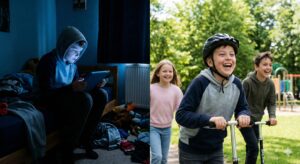
The Neighborhood Shapes The Childhood
– Where you live quietly determines how your kids grow up
When parents talk about moving, they usually start with the house. More bedrooms. A better kitchen. A dedicated home office. Those things matter. But here’s the quieter truth most families don’t realize until years later: The house shapes how you live, but the neighborhood shapes who your kids become.
And most neighborhoods today are doing far more shaping than parents intend.
Childhood Doesn’t Happen Inside a Floor Plan
Parents don’t picture childhood as a square-footage problem. They imagine bikes dropped in the driveway. Muddy shoes by the door. Kids calling out names of neighborhood friends as they run from house to house. Long summer evenings that stretch just a little past bedtime.
But modern neighborhoods weren’t designed for that version of childhood. They were designed for cars. For efficiency. For adults commuting in and out, garages opening and closing, families living next to each other without ever truly living together.
The result is subtle but powerful:
- Kids stay inside because there’s nowhere obvious to go
- Parents schedule play instead of allowing it to happen naturally
- Screens fill the gap where the environment once did the work
And slowly, unintentionally, childhood moves indoors. Not because parents chose it — but because the neighborhood made it easier.
Why Willpower Isn’t Enough
When kids spend too much time on devices, parents often blame themselves. “We should limit screen time more.” “We should push them outside.” “We should be more intentional.” But behavior doesn’t happen in a vacuum. It responds to friction and ease.
If the outside world feels far away, empty, unsafe, or designed primarily for cars, then staying inside isn’t a failure of parenting. It’s a rational response to the environment. And environment always wins over intention. That’s true for adults. And it’s especially true for kids.
The Forgotten Power of Proximity
Think about your own childhood for a moment. Chances are, the things that defined it weren’t planned. They happened because:
- Friends lived close enough to walk
- Parks were visible, not hidden behind roads
- Parents felt comfortable letting kids roam
Play didn’t require coordination. It required proximity. Modern neighborhoods often break that chain. Parks exist — but they’re separated by busy streets. Trails exist — but they’re out of sight. Amenities exist — but they feel like destinations, not extensions of your home. When play requires transportation, it becomes optional. When it’s optional, it disappears.
How Neighborhoods Teach Kids What’s Normal
Kids learn what’s normal by watching what everyone else does. If they see:
- Other kids outside after school
- Bikes leaning against fences
- Pick-up games forming without adults organizing them
They learn that being outside is just… what kids do.
But if they see:
- Empty sidewalks
- Closed garage doors
- No obvious gathering places
They learn something else entirely. Not through words. Through observation. Because neighborhoods teach norms faster than parents ever can.
The Cost Parents Don’t See Until Later
No parent wakes up one day and decides, I want my child to spend most of their childhood indoors. It happens quietly. One year at a time. One habit at a time. One convenience at a time. Then suddenly:
- Your teenager doesn’t want to leave their room
- Your family memories are mostly indoors
- You realize you didn’t get as many unscheduled moments as you thought you would
And the hardest part? You can’t rewind their environment. You can only change it going forward.
What Happens When Neighborhoods Are Designed for Kids Again
Candlelight Homes is asking a different question. Not: How many homes can we fit here? But: What kind of childhood will happen here?
When that question leads the community design, everything changes. Skate parks aren’t leftovers — they’re central. Trails aren’t hidden — they connect daily life. Pickleball courts aren’t “someday” — they exist now, inviting use.
Kids don’t need to be told to go outside. They just… do. Parents don’t need to orchestrate everything. They just watch it unfold.
Firefly: A Neighborhood Built Around Childhood
At Candlelight Homes, the team behind Firefly started with a simple but uncommon idea:
What if the neighborhood did the heavy lifting for parents? Instead of asking families to fight against their environment, Firefly was designed to support the life parents already want for their kids. That meant:
- Over 350 acres dedicated to parks, trails, and open space
- Amenities built before the first home was sold so kids didn’t have to wait
- A full-time Activities Director to make connecting with family and friends easy
- Spaces that invite unstructured play, not just programmed events
Not as marketing features — but as infrastructure for childhood.
Why “Unstructured Play” Matters More Than Ever
Unstructured play isn’t a buzzword. It’s a developmental necessity. It’s how kids:
- Learn conflict resolution
- Practice independence
- Discover who they are without constant adult direction
But unstructured play can’t happen on command. It needs:
- Safety
- Other kids
- A place that invites lingering
Firefly’s design doesn’t force unstructured play. It removes the obstacles that prevent it. And that makes all the difference.
The Quiet Relief Parents Feel
Parents who walk through Firefly often notice something before they can articulate it. A sense of relief. Not because everything is perfect — but because the pressure lifts. The pressure to:
- Constantly entertain
- Schedule every interaction
- Compete with screens through rules alone
The neighborhood shares the responsibility. And that’s something most parents didn’t realize they were missing until they felt it.
This Isn’t About Nostalgia
It’s tempting to frame all of this as nostalgia. Things were better when we were kids. But this isn’t about recreating the past. It’s about applying what we know about human behavior.
- Kids still want to play
- Parents still want connection
- Environment still shapes outcomes
That hasn’t changed. What has changed is whether neighborhoods are designed with that truth in mind.
Choosing a Neighborhood Is Choosing a Childhood
When families choose where to live, they’re making a decision that reaches far beyond today’s needs. They’re choosing how much of their kid’s childhood happens outside the home. Those outcomes aren’t accidental. They’re built. And once you see that, it’s hard to unsee.
A Final Thought for Parents
No neighborhood can guarantee a perfect childhood. But Firefly makes the right things easier — and the wrong things harder. Candlelight Homes quietly aligns with what parents already value, instead of working against it.
Firefly was designed with that belief at its core. Not to sell a lifestyle. But to support one. Because in the end, the most important thing your home can give your family isn’t a feature. It’s a childhood that has room to unfold.
Come visit Firefly. Where the neighborhood you want them to have – actually exists.